


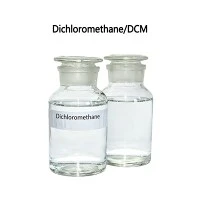


Dichloromethane, also known as methylene chloride or DCM, has the chemical formula CH2Cl2 and the CAS number 75-09-2. It is a colorless, volatile liquid with a pungent, chloroform-like odor, and it is one of the most commonly used solvents in industry and laboratories. Its density is one of the first properties engineers and chemists look up, because it governs phase separation, dosing and safety in almost every application. This article gives the standard density values and explains what affects them.
What Is the Density of Dichloromethane?
The liquid density of dichloromethane is approximately 1.325 g/mL at 25 °C and 1.326-1.330 g/cm³ at 20 °C. Because water has a density of about 1.0 g/mL, DCM is markedly heavier than water, so in an aqueous mixture the dichloromethane layer settles at the bottom. This value is experimentally determined and serves as a critical indicator for evaluating both its applications and its safe handling.
Dichloromethane Physical Properties at a Glance
| Property | Value |
| Chemical formula | CH2Cl2 |
| CAS number | 75-09-2 |
| Appearance | Colorless liquid |
| Density at 20 °C | 1.326-1.330 g/cm³ |
| Density at 25 °C | About 1.325 g/mL |
| Boiling point | 39.6 °C |
| Melting point | -96.7 °C |
| Solubility in water | About 13 g/L at 20 °C |
| Refractive index at 20 °C | 1.424-1.425 |
What Affects Dichloromethane Density?
Temperature is the main variable. As temperature rises, molecular motion increases and the liquid expands, so the density falls. For example, DCM density decreases to roughly 1.28 g/cm³ at 50 °C, while lower temperatures give higher densities. Pressure has a smaller but measurable effect: increasing pressure compresses the liquid slightly and raises its density. For precise process calculations, the density should always be taken at the actual operating temperature rather than assumed from a single reference value.
Why Density Matters in Practice
Phase separation: in extraction work, the DCM layer forms the lower phase, which determines how the separatory funnel is drained.
Process design: density values feed directly into mass balances, pump sizing and reactor volume calculations.
Quality control: density measurement is a quick check of purity and batch consistency for DCM deliveries.
Safety: the high density and low boiling point mean DCM vapors are heavy and tend to collect at floor level, so ventilation must be designed accordingly.
Handling and Safety Notes
Dichloromethane is volatile and its vapors can cause dizziness, headache and, at high concentrations, loss of consciousness, so it must be used with effective ventilation. Prolonged skin contact degreases the skin and should be avoided with suitable gloves. Regulatory agencies have classified DCM as a potential carcinogen under certain exposure conditions, so workplace air monitoring and adherence to occupational limits are recommended. Store the solvent in tightly sealed containers away from heat, open flames and strong oxidizers.
Frequently Asked Questions
What is the density of dichloromethane?
About 1.325 g/mL at 25 °C and 1.326-1.330 g/cm³ at 20 °C, which makes DCM about one-third heavier than water.
Is dichloromethane heavier than water?
Yes. With a density near 1.33 g/mL against about 1.0 g/mL for water, DCM sinks and forms the lower layer in aqueous mixtures.
Does temperature affect dichloromethane density?
Yes. Density decreases as temperature increases, for example to roughly 1.28 g/cm³ at 50 °C, so density should be measured at the working temperature.
Why is DCM density important in extraction?
Because DCM is the denser layer, it settles below the aqueous phase, which determines how the layers are separated and drained in a separatory funnel.
What is dichloromethane used for?
DCM is used as a solvent in paint stripping, extraction, degreasing, chromatography and chemical synthesis, and in some food and pharmaceutical processes where food-grade purity is required.
Is dichloromethane safe to handle?
It must be handled with ventilation and protective equipment because its vapors affect the nervous system and the solvent is a suspected carcinogen at high exposure; follow occupational limits and label instructions.