


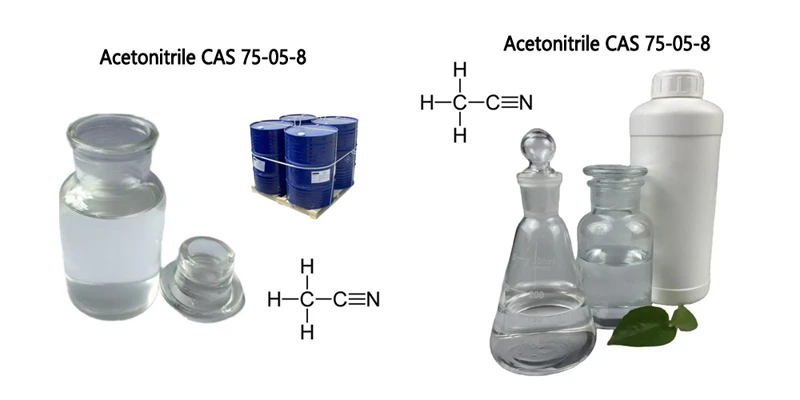
Acetonitrile (ACN) is an organic compound with the chemical formula CH₃CN, registered under CAS number 75-05-8, and is the simplest organic nitrile. It consists of a methyl group (-CH₃) bonded to a nitrile group (-C≡N), giving a molecular formula of C₂H₃N and a molecular weight of 41.05 g/mol. While hydrogen cyanide (HCN) has a simpler structure, the cyanide anion (CN⁻) is not classified as organic, which is why acetonitrile - rather than HCN - is considered the simplest organic nitrile. Acetonitrile is produced mainly as a by-product of acrylonitrile manufacturing and is one of the most widely sourced polar aprotic solvents for HPLC analysis, pharmaceutical extraction, and organic synthesis.

Acetonitrile Solubility in Water and Organic Solvents
Acetonitrile is fully miscible with water in all proportions and dissolves readily in most common organic solvents. This dual solubility profile is a key reason buyers specify acetonitrile for chromatography and extraction applications:
- Water solubility: Acetonitrile is completely miscible with water at any ratio, with no solubility limit - a property that supports its use as a mobile-phase solvent in reversed-phase HPLC, where water-acetonitrile gradients are standard.
- Organic solvent solubility: Acetonitrile is miscible with methanol, ethanol, diethyl ether, carbon tetrachloride, methyl acetate, ethyl acetate, and dichloroethane.
- Polarity indicator: Acetonitrile has a log P (octanol-water partition coefficient) of approximately -0.54, confirming its classification as a strongly polar, aprotic solvent - the exact profile pharmaceutical and analytical labs look for when sourcing acetonitrile for LC-MS or UPLC mobile phases.
Acetonitrile Chemical Properties and Polarity
Acetonitrile is a polar molecule because the nitrogen atom in its nitrile group is significantly more electronegative than the carbon and hydrogen atoms, creating a strong dipole across the C≡N triple bond. This electronegativity difference - not an electrical charge, since the molecule itself is neutral - is what gives acetonitrile its characteristic polarity and explains why it functions so effectively as a polar aprotic solvent in nucleophilic substitution reactions, electrochemistry, and as a chromatography mobile-phase component.
Acetonitrile Physical Properties and Specification Data
Acetonitrile has a boiling point of 81.3-82.1°C, a melting point of -46 to -44°C, and a density of approximately 0.786 g/cm³. Buyers comparing acetonitrile suppliers or verifying a Certificate of Analysis (COA) typically check the following specification data:
| Property | Value |
|---|---|
| Molecular weight | 41.05 g/mol |
| Boiling point | 81.3-82.1°C |
| Melting point | -46 to -44°C |
| Density | 0.783-0.786 g/cm³ |
| Flash point | ~6°C (closed cup) |
| Autoignition temperature | 524°C |
| Vapor pressure | 9.71 kPa (20°C) |
| Vapor density | 1.4 (vs. air) |
| Appearance | Colorless, transparent liquid, ether-like odor |
| UV cutoff (HPLC grade) | ~190 nm |
These figures are compiled from publicly available references (Wikipedia, NIST Chemistry WebBook, ChemicalBook); actual batch data should always be confirmed against the supplier's COA before purchase, particularly for HPLC-grade or spectrophotometric-grade acetonitrile where UV cutoff and water content are critical specifications.
Acetonitrile Safety Data and Handling for Bulk Purchase
Acetonitrile is a highly flammable liquid with an NFPA fire rating of 3, and its vapor forms explosive mixtures with air at concentrations of 4-16% by volume. Perhaps the most important safety fact often omitted from general product descriptions: acetonitrile can be metabolized in the body into cyanide, and acute exposure may cause delayed symptoms including reduced heart rate, respiratory depression, pallor, and kidney impairment - which is why full PPE (including self-contained breathing apparatus in high-exposure scenarios) is required when handling bulk quantities.
Regulatory and shipping data relevant to procurement teams:
- Occupational exposure limits: ACGIH TLV-TWA of 40 ppm, STEL of 60 ppm
- UN number: 1648 (Flammable liquid, Class 3, Packing Group II)
- US EPA status: Listed as a Hazardous Air Pollutant (HAP)
- Fire response: Use foam, CO₂, or dry chemical extinguishers; water may be ineffective and can spread vapor
Buyers importing or transporting acetonitrile in bulk should request the full Safety Data Sheet (SDS) and confirm compliance with destination-country transport and storage regulations before shipment.
Common Synonyms Used in Acetonitrile Trade and Literature
In supplier catalogs and technical literature, acetonitrile is also listed as methyl cyanide or cyanomethane - all referring to the same CAS 75-05-8 compound. Cross-referencing database identifiers helps avoid confusion when comparing quotes across multiple suppliers: PubChem CID 6342, ChemSpider ID 6102, ChEBI:38472, and EC number 200-835-2 all point to the identical substance regardless of the trade name used.
Acetonitrile Grades: HPLC, ACS Reagent, and Industrial Grade
Acetonitrile is sold across several purity grades, with HPLC/chromatography grade (≥99.9% purity, low UV absorbance, low water content) being the most commonly sourced grade for pharmaceutical and analytical laboratories. This is the single most important buying decision for most acetonitrile purchasers: HPLC-grade and LC-MS-grade acetonitrile are filtered and tested for trace metals, water content, and UV absorbance at 190-200 nm, since impurities at this level can distort chromatography baselines or mass spec background noise. ACS reagent grade and industrial/technical grade acetonitrile, by contrast, are suited to bulk extraction, battery manufacturing intermediates, and rubber product processing, where analytical-grade purity is unnecessary and cost efficiency matters more.
Primary Applications Driving Acetonitrile Demand
The leading application of acetonitrile is as a mobile-phase solvent in HPLC and UPLC analysis, followed by use as a polar aprotic solvent in organic synthesis, DNA/oligonucleotide synthesis (as a solvent for phosphoramidite reagents), and vegetable/animal oil extraction. Acetonitrile is also used as a chemical intermediate in battery and rubber product manufacturing, and its low viscosity and volatility make it useful in electrochemistry as a solvent for supporting electrolytes. Given how tightly analytical-grade demand is tied to purity specifications, buyers sourcing acetonitrile for pharmaceutical QC, environmental testing labs, or contract research organizations (CROs) should always specify the required grade - HPLC, spectrophotometric, or ACS reagent - when requesting quotes.